Blockchain Tracing vs Blockchain Forensics: Key Differences
Blockchain tracing follows transactions and asset movements across addresses and networks. Blockchain forensics is a broader investigation that tests what those movements mean, combines on-chain data with other records and documents the basis for an attribution or finding. If funds were stolen, start by preserving the transaction hashes, wallet addresses, messages and platform records before buying an analysis. A trace can identify leads, but neither a colourful chart nor a service label alone proves who controlled an account or that funds can be recovered.
The Practical Distinction
The terms overlap in marketing, but the intended deliverable matters more than the label. Ask what question the work will answer and what evidence will support the answer.
| Question | Blockchain tracing | Blockchain forensics |
|---|---|---|
| Primary task | Follow a specified asset or value flow | Reconstruct, test and explain a transaction or incident |
| Typical input | Hash, address, asset, network, dates | On-chain data plus account exports, messages, device or provider records |
| Typical output | Transaction path, wallet clusters and service leads | Reproducible findings, methods, caveats and evidence index |
| Key limit | A path does not identify a human owner | Off-chain facts may still be unavailable without cooperation or legal process |
| Useful next step | Notify a plausible receiving service or investigator | Support a complaint, investigation, preservation request or claim |
A trace is often part of a forensic analysis. A forensic report can also conclude that a particular attribution is not supportable. An honest limitation is useful: it prevents a speculative address label from being passed to police or a court as a verified identity.
What Public Blockchain Data Can Show
Depending on the network, an analyst can verify a transaction hash, timestamp or block, sending and receiving addresses, asset, amount and subsequent on-chain movements. The exact interpretation may vary with token contracts, account models and bridges. A receiving address may be associated with a service in a tool or public source, but the public chain generally does not display the customer’s name behind a custodial account.
Europol’s report on cryptocurrencies and criminal finances explains why blockchain analysis can help investigations while pseudonymous use and other techniques complicate them. Visibility is not the same as immediate identification. A transfer into a pooled exchange address can be a useful lead, but internal account allocation and customer records sit with the service.
For a theft investigation, Can Stolen Crypto Be Traced and Recovered? is a separate question. Recovery depends on reachable assets, a service capable of action and a valid legal or investigative route, not simply on following a line through an explorer.
How a Basic Trace Is Built
- Confirm the starting point. Record the correct network, full hash, asset contract if relevant, sending and receiving addresses, amount and time.
- Verify the loss. Match the blockchain transaction to your exchange withdrawal or wallet record and the instruction that led to it.
- Follow subsequent on-chain transfers. Record hashes and amounts, noting splits, consolidations, fees and swaps.
- Mark possible services or bridges. State the basis of each label and its confidence level.
- Stop where visibility ends. A transfer into a custodian, privacy technique or unsupported network may require different data.
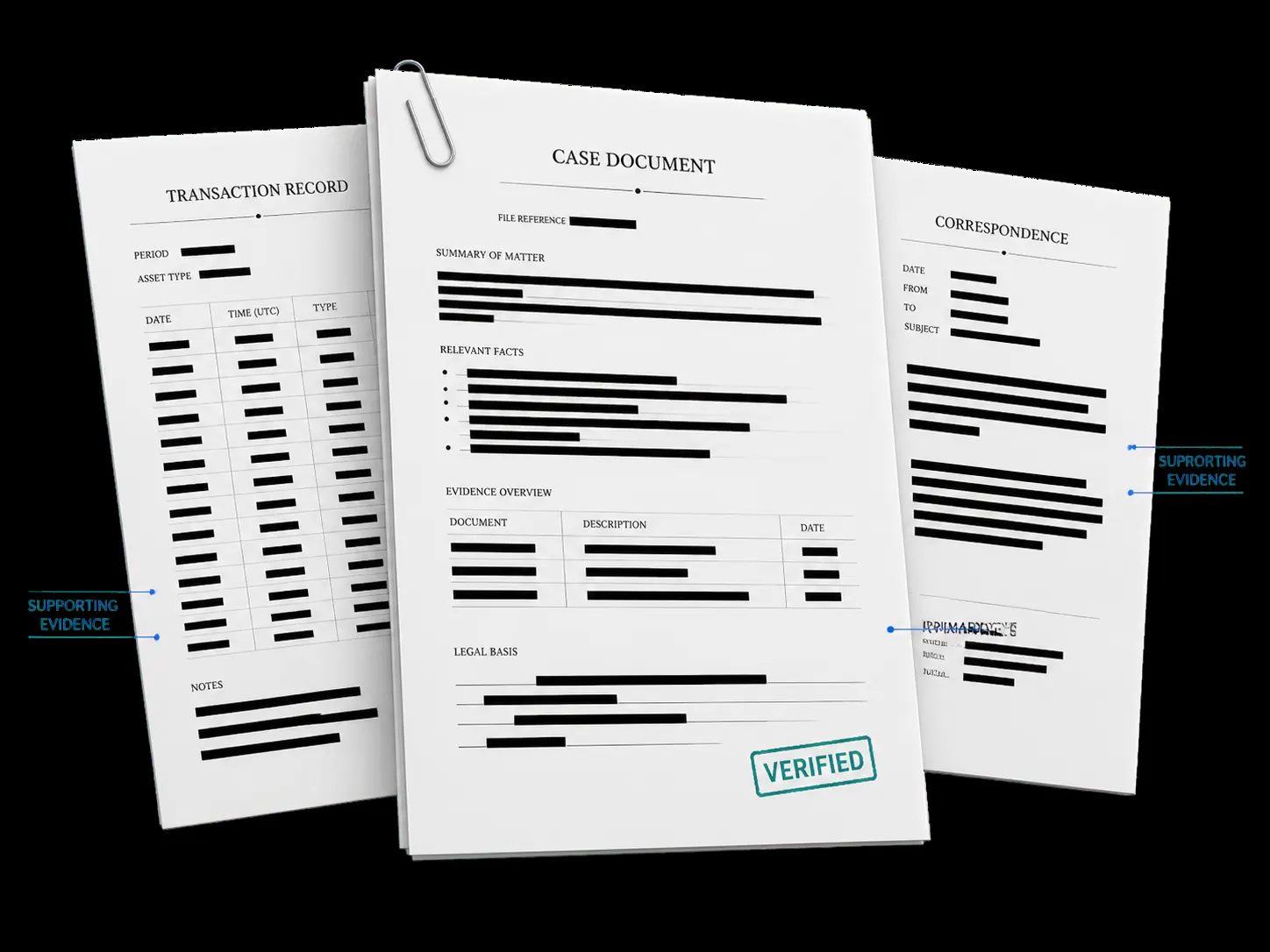
- Preserve the source list. Another reviewer should be able to reproduce the path without relying on a screenshot of a diagram.
An explorer link is helpful but not enough. Save a transaction schedule in a stable format, including the date you accessed each source. A working chart should point to the underlying hashes rather than substitute for them.
What the Forensic Layer Adds
Context and Attribution
Forensics connects a payment to the circumstances around it: the email or chat that gave the address, the platform account from which the transfer was made, the fake investment dashboard, the wallet approval or the bank payment that funded a purchase. It separates verified facts, third-party labels, analytical inference and allegations made by a suspect.
For example, a token sent from a victim’s wallet to address A is an on-chain fact. A commercial tool’s label that address A belongs to Exchange X is a lead. The assertion that customer Y at Exchange X controlled those funds requires additional evidence. A forensic report should keep those propositions distinct.
Alternative Explanations
A defensible analysis asks whether an address was a service deposit, a smart contract, a bridge or a change address; whether a similar amount is coincidental; and whether later movements can be linked with confidence. A pooled balance may break a simple coin-by-coin narrative. On account-based networks, token transfers and contract interactions need to be interpreted in their actual context.
Preservation and Reproducibility
Record source URLs, full identifiers, access dates, exports, tool versions where material, analytical steps and uncertainty. Keep originals of emails, provider statements and images separate from annotated copies. A clear evidence index helps an investigator understand which conclusion is supported by which item.
The Crypto Scam Investigation: Evidence to Preserve guide covers the surrounding records that a chain graph omits.
Where Each Service Is Useful
| Situation | Useful scope | Deliverable to request |
|---|---|---|
| One recent transfer to a suspected exchange | Focused trace and verification of service lead | Hash list, basis for label and concise notification packet |
| Scam across wallets, swaps and networks | Multi-network forensic reconstruction | Dated flow, assumptions, unresolved hops and supporting evidence |
| Dispute over who authorised a transfer | Account, wallet, device and communication analysis | Chronology of access and transfers with limits clearly stated |
| Compliance review of your own deposits | Provenance mapping rather than criminal attribution | Acquisition and wallet route tied to bank and exchange records |
| Police or legal submission | Clear, reproducible evidence file | Method, exhibits, factual findings and confidence levels |
Tracing your own deposit for Source of Funds differs from tracing stolen assets. In the first, you can supply bank, account and wallet records; in the second, the most important account data may be held by a third party.
For a Source of Funds case, see How to Prove Source of Funds for Crypto.
What Happens When Funds Reach a Service
Notify the relevant provider through its genuine fraud or security channel with the full network, hash, addresses, asset, amount, time and short explanation. Ask it to review the suspected destination, preserve relevant records and explain the channel for competent authority requests.
Do not demand a stranger’s private account details on the strength of a public address label. Send the case reference to the investigating authority.
Eurojust’s description of cross-border electronic evidence work explains why access to information held by service providers often requires competent authorities and legal cooperation. Private analysts can identify what records may matter; they cannot issue an official preservation or production order. For cross-border asset recovery, Eurojust’s asset recovery overview likewise describes support to judicial authorities, not a consumer self-service mechanism.
If the lead is promising, a lawyer may assess whether a formal complaint, local order or coordination with investigators is justified. See When Do You Need a Crypto Recovery Lawyer?. Time matters for notifications, but speed does not excuse unsupported assertions.
What a Credible Report Should Contain
- The question investigated, scope, networks, addresses and time period.
- The victim’s starting transaction and how it was verified against their own records.
- A table of every material hash and any inferred link between transactions.
- Sources for service labels and an explicit confidence statement for each attribution.
- Explanations of swaps, bridges, pooled addresses, partial flows and gaps.
- Separate sections for facts, analytical hypotheses and recommended next requests.
- A precise conclusion: what can be reported now and what remains to be checked.
An analyst should not promise to “recover” assets merely because they can produce a report. Ask whether the proposed work will change a decision: identify a plausible service, support a police supplement, correct a provider submission or establish that further spending is not proportionate.
Common Mistakes
- Treating a commercial cluster label as the identity of the account holder. Report it as a service lead until corroborated.
- Assuming the current balance at an address is the recoverable amount. Assets may have moved, been pooled or never belonged to the suspected person.
- Confusing an internal exchange reference with an on-chain hash. Ask the platform which identifier it can provide.
- Ignoring token contracts, bridges or fees when amounts change. Explain each step and stop where matching becomes uncertain.
- Sending only a visual graph to investigators. Include the underlying transaction list and source records.
- Paying a provider for a guaranteed freeze or seizure. A private tracing firm cannot guarantee an authority or platform decision.
Frequently Asked Questions
Is blockchain tracing the same as recovering crypto?
No. Tracing can show movements and possible service leads. Recovery may require an identifiable custodian or counterparty, preservation of assets, a valid claim and action by a provider or authority. Many traces end without a return.
Can forensics name the person behind a wallet?
Sometimes other reliable records can support an attribution, but the public address alone normally does not display a legal identity. A tool label or clustering inference should be stated with its basis and limits. Custodial account information generally requires the service or lawful process.
Is a free block explorer enough?
For a simple transaction, it can verify the hash and subsequent visible transfers. Complex routes and a submission intended for an investigation may need systematic records, context and independent review. Paid software is not proof by itself.
What if the funds crossed a bridge or were swapped?
Document both sides of each operation, asset, contract, network and time. Some links can be demonstrated from transaction data; others are only probabilistic or require provider records. Do not join two flows solely because their values look similar.
Will police accept a private forensic report?
The authority decides what it considers and which investigative steps it takes. A concise, reproducible report with source files is more useful than an unsupported conclusion. Report the suspected crime even if the forensic analysis is incomplete.
Get a Case Assessment
If you have a verified loss and need to know whether a trace can support a practical next step, Get a Free Case Assessment from P&P Crypto Asset Recovery. Share the starting hashes, networks, platform records and a short chronology through a verified channel. We can scope the analysis and legal route without promising identification, a freeze or return.
Legal Support for Crypto Asset Issues

Support when access, withdrawals or transactions are restricted.

Clear evidence mapping and structured responses to compliance requests.

Evidence preservation and coordinated escalation after a scam or disputed transfer.
Cases Related to This Topic
 Case study
0.7 BTC Unblocked After AML/CTF Review by a Crypto Exchange
- Amount
- 0.7 BTC
- Issue
- AML/CTF transaction freeze
- Outcome
- Funds fully unblocked
 Case study
Bybit Account Unblocked Following a Compliance Review
- Amount
- 5 BTC + US$30,000 in USDT
- Issue
- Account restricted for compliance review
- Outcome
- Account access restored
 Case study
Bybit Account Unblocked After a Legal Opinion and Funds Review
- Amount
- Amount not disclosed
- Issue
- Bybit account restriction and source-of-funds review
- Outcome
- Account access restored
Get a Clear View of Your Options
Tell us what happened. We aim to respond in English within one business day.
- Evidence-led first review
- EU/EEA and cross-border support
- No seed phrases or private keys required