How to Prove Source of Funds for Crypto
To prove the source of funds for crypto, show where the money or assets originally came from and how they reached the transaction under review. A payslip alone rarely explains a deposit that passed through a bank, another exchange and a self-hosted wallet. Start with the provider’s exact request, identify the affected transfer, and assemble a short, dated chain of records. The documents accepted and the review outcome depend on the provider, the transaction and the applicable jurisdiction.
What the Exchange Is Trying to Establish
Source of Funds, or SoF, concerns the origin of the assets involved in a particular payment, deposit or balance. It may be requested when you make a large deposit, change your usual pattern, transfer from an outside wallet or undergo a periodic account review. A request is not, by itself, an accusation of wrongdoing.
The provider may ask separate questions. Do not answer one and assume it answers them all.
| Question | Evidence that can answer it | What remains unproven |
|---|---|---|
| How were the funds earned or obtained? | Employment, business, sale, inheritance or investment records | Whether this particular transfer used those funds |
| Were the funds received by you? | Bank credit, settlement record, exchange account statement | Their later route into the reviewed account |
| How were cryptoassets acquired? | Fiat funding, purchase and trade history | Control of a later external wallet |
| How did assets reach this exchange? | Withdrawal record, wallet history, transaction hash and matching deposit | An earlier source of income or an unrecorded internal transfer |
Kraken’s explanation of Source of Funds describes the same distinction in practical terms: evidence of how money was obtained, evidence it was received and, if it has already reached the account, evidence of the transfer in. The provider’s own request remains the controlling checklist for your case.
If you are unsure whether the exchange means the origin of a specific transaction or your broader financial history, compare Source of Funds with Source of Wealth before uploading documents.
Build One Traceable Chain
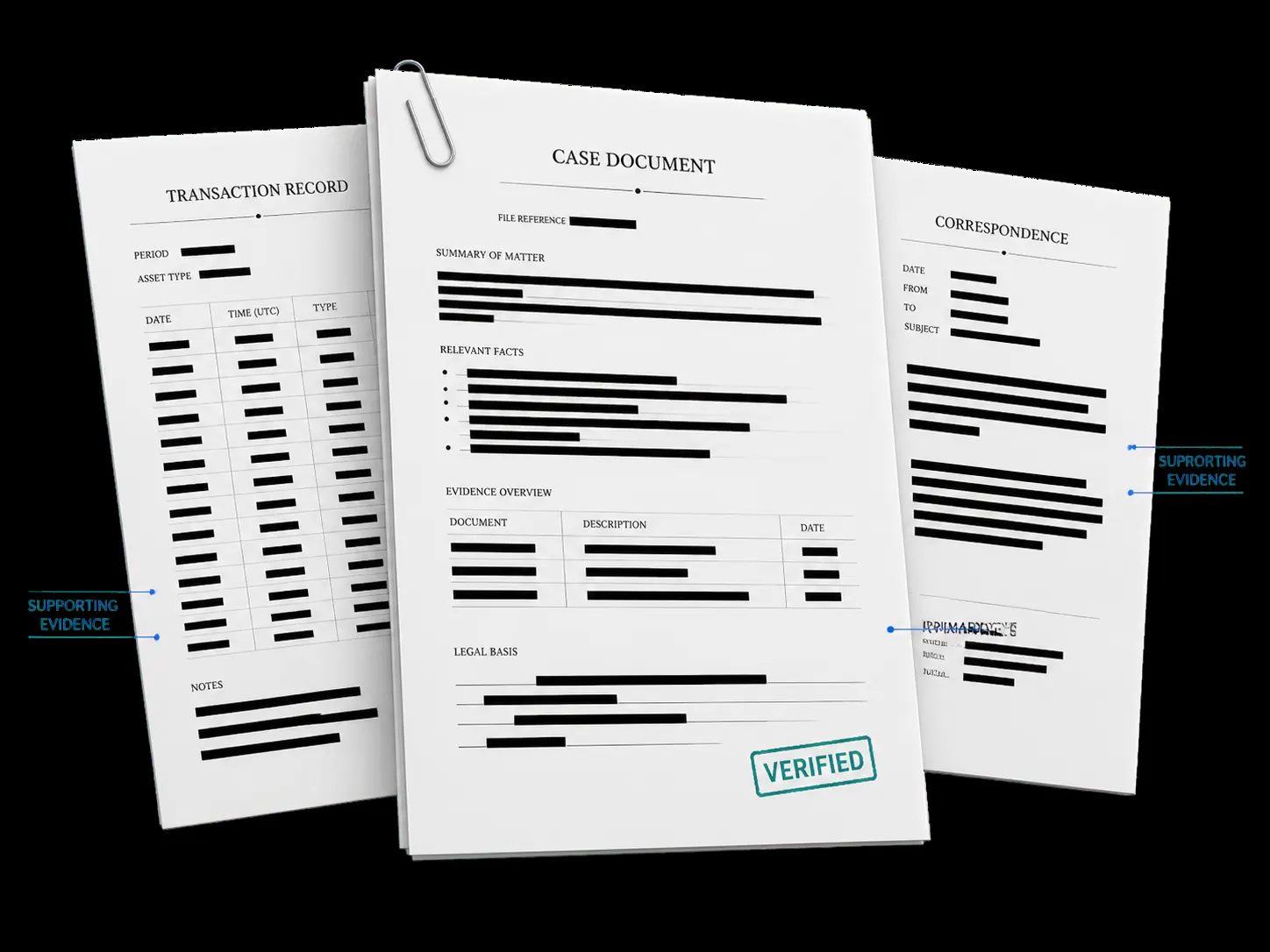
Choose one deposit or group of related deposits and work backwards. Give each record a number so the reviewer can follow the movement without reconstructing it from screenshots.
- Identify the reviewed deposit: asset, amount, network, date, account reference and any transaction hash.
- Identify the sending wallet or exchange and obtain its withdrawal or transfer record.
- If the crypto was bought elsewhere, export the purchase and trade record showing the account holder, fiat amount and acquired asset.
- Match the purchase to the bank or card payment that funded it.
- Add the record explaining the underlying source: salary, business proceeds, sale proceeds, savings, gift, inheritance or another genuine source.
- Note conversions, fees, partial transfers and time gaps in a short chronology.
For example, a salary-funded BTC deposit may be documented by payslip → salary credit in a named bank account → transfer to Exchange A → BTC purchase → withdrawal to your wallet → on-chain transfer → deposit at Exchange B. Do not claim that two amounts should match exactly if trading, market movement or fees explain a difference. State the actual figures and dates.
The transaction hash proves a transfer on the relevant network, but it does not prove where the original money came from. A bank statement can prove a payment from your account, but not always the asset purchased with it. The value lies in matching the records.
Which Evidence Fits Your Source
| Source | Useful documents | Important link to add |
|---|---|---|
| Employment or pension | Payslips, employer letter, pension statement, bank credits | Payment from the same account into the crypto purchase |
| Freelance or business income | Client contracts, invoices, tax filing, company accounts, business bank credits | Lawful transfer from business to personal account if you invested personally |
| Property or investment sale | Sale agreement, completion or broker statement, settlement credit | Transfer or purchase made using those proceeds |
| Inheritance or gift | Probate, distribution record or gift letter, transfer receipt | Receipt by the account holder and subsequent crypto acquisition |
| Earlier crypto purchase | Historic exchange statements, fiat purchase and withdrawal records | Later wallet movements, swaps and current deposit |
| Mining or staking | Payout history, pool or platform record and wallet receipts | Link between the credited rewards and the reviewed deposit |
| P2P purchases | Order history, counterparty payment reference, bank transfer and wallet receipt | Match each payment to an actual crypto delivery |
Coinbase’s document guidance gives examples of bank, exchange, wallet, mining, employment and sale records. Its listed formats and age requirements are platform specific; do not assume another exchange will accept the same combination. A fuller document comparison is available in Crypto Proof of Funds: Documents Exchanges May Request.
Handle Difficult Transaction Histories Honestly
Old Purchases and Missing Exchange Records
Request account statements from the original provider and search bank archives for matching payments. An old confirmation email may help identify the date and reference, but it is weaker than an account export. If the exchange has closed, explain that gap and provide available bank records, tax reports, wallet history and contemporaneous correspondence. Do not manufacture an account statement or describe a reconstructed spreadsheet as an original record.
Self-Hosted Wallets, Swaps and Bridges
Record each wallet address, network, token and transaction hash. Explain whether you controlled each wallet and how that can be demonstrated through a platform-linked withdrawal or another legitimate verification method. A bridge transaction and receipt on a second network should be paired; the same value may appear in a different token. Do not share a seed phrase or private key to prove ownership.
Third-Party and P2P Payments
Show who paid whom and why. If a relative funded a purchase or a P2P counterparty paid through a different name, do not conceal the discrepancy. Provide the order, payment, delivery and any agreement, then explain the relationship. The reviewer may need more information or may refuse a transaction it cannot reconcile with its policy.
Corporate Funds Used by an Individual
A business bank statement does not automatically explain a personal investment. Add the company ownership or authority, the underlying business revenue, and the lawful dividend, salary, loan or other transfer to the individual where applicable. Keep the company and personal accounts distinct in the chronology.
Submit a Focused Explanation
Reply in the existing secure compliance ticket. Quote its reference and the particular deposit or period. A compact cover note could say:
“The [amount and asset] deposited on [date] came from [source]. Files 1–2 show receipt of the original funds; files 3–5 show their purchase and transfer through [services/wallets]; file 6 matches the deposit. The [difference] reflects fees and a partial conversion. Please confirm whether this addresses the requested Source of Funds evidence or identify the missing link.”
Attach readable originals or provider-generated PDFs/CSVs, plus a one-page index. Check that names, dates, currencies and account identifiers are visible. Ask the provider before redacting a field that it expressly needs; retain an unmodified original. Use its genuine app or secure upload portal, never an address supplied by an unsolicited “agent.”
The EBA’s guidance on ML/TF risk factors for crypto-asset service providers explains the risk-based context of these checks. It does not prescribe one universal set of documents for every customer. A crypto AML review may lead to further questions after the first submission.
What Happens After Submission
The provider may accept the explanation, request a missing statement, ask about a specific wallet or third party, retain restrictions while reviewing, or decide it cannot continue the relationship. Save the upload confirmation and every response. If the request changes, answer the new question with an updated index rather than repeatedly sending the entire archive.
If an in-scope EU crypto-asset service provider does not address a coherent request or you dispute its decision, consider its formal complaints procedure. MiCA Article 71 requires complaint procedures for providers within its scope; it does not guarantee that documents will be accepted or that withdrawals will resume. Legal help is proportionate when documents conflict, assets are substantial, several entities are involved or a formal escalation is needed.
Mistakes That Slow a Source of Funds Review
- Sending only a payslip for a crypto deposit. Add the bank, purchase and transfer records that connect it to the deposit.
- Uploading a blockchain explorer screenshot without the network and full hash. Include the underlying transfer details and the account export.
- Treating a tax return as a transaction receipt. It may explain income over a period but rarely proves a particular wallet transfer.
- Hiding a third-party payment or changing the story between tickets. State the discrepancy and support it with records.
- Sending unrelated years of statements. Identify the relevant transactions and ask if a wider period is required.
- Sharing credentials or an entire wallet with someone offering to “certify” funds. Use ordinary records and verified platform channels.
Frequently Asked Questions
Is a bank statement enough to prove Source of Funds?
Sometimes, if it shows both the source and the payment into the reviewed service. If you purchased crypto elsewhere or used external wallets, the provider may also need the purchase, withdrawal and on-chain records. Check exactly which transaction it is reviewing.
What if the crypto was bought years ago?
Use the original exchange history and bank records if available, then bridge the intervening wallet activity. Explain any records that no longer exist and distinguish original documents from reconstructions. The provider decides whether the remaining evidence is sufficient.
Can a tax report replace missing trades?
A tax report can help summarise acquisition and disposal history, but it may rely on your imported data and may not prove each transaction independently. Supply its underlying exchange exports, wallet records or bank entries where possible.
Should I prove ownership by signing a message?
Only if the genuine provider offers a safe, clear procedure and you understand exactly what you are signing. A message signature can address control of a wallet, not the lawful origin of funds. Never enter a seed phrase into a site or share a private key.
What if the provider rejects a complete submission?
Ask which link or document remains insufficient and retain its answer. Correct any verifiable error, then use the formal complaint route if appropriate. A lawyer can assess whether the evidence and amount justify further action through When Do You Need a Crypto Recovery Lawyer?.
Get a Case Assessment
If a substantial balance remains restricted or the acquisition history spans several services, Get a Free Case Assessment from P&P Crypto Asset Recovery. Send the provider’s request, a one-page timeline and the core records through a verified channel. We can identify the missing link and an appropriate next submission; no outcome is guaranteed.
Legal Support for Crypto Asset Issues

Support when access, withdrawals or transactions are restricted.

Clear evidence mapping and structured responses to compliance requests.

Evidence preservation and coordinated escalation after a scam or disputed transfer.
Cases Related to This Topic
 Case study
0.7 BTC Unblocked After AML/CTF Review by a Crypto Exchange
- Amount
- 0.7 BTC
- Issue
- AML/CTF transaction freeze
- Outcome
- Funds fully unblocked
 Case study
Bybit Account Unblocked Following a Compliance Review
- Amount
- 5 BTC + US$30,000 in USDT
- Issue
- Account restricted for compliance review
- Outcome
- Account access restored
 Case study
Bybit Account Unblocked After a Legal Opinion and Funds Review
- Amount
- Amount not disclosed
- Issue
- Bybit account restriction and source-of-funds review
- Outcome
- Account access restored
Get a Clear View of Your Options
Tell us what happened. We aim to respond in English within one business day.
- Evidence-led first review
- EU/EEA and cross-border support
- No seed phrases or private keys required