Crypto Source of Funds vs Source of Wealth
Source of Funds asks where the assets involved in a particular crypto transaction came from. Source of Wealth asks how you built your broader financial position over time. An exchange may request either or both, and the same document can help answer one without resolving the other. Read the exact notice, identify the transaction or period, and prepare a short explanation with records suited to each question. The standard and outcome depend on the provider and jurisdiction.
The Distinction in One Example
Suppose you deposit €40,000 worth of BTC acquired on another exchange five years ago. Your Source of Funds file should connect the fiat used to buy that BTC, the purchase, withdrawals, intervening wallet movements and today’s deposit. Your Source of Wealth explanation might cover years of employment income, business proceeds, investment gains or inheritance that explain your overall holdings. A recent bank balance does not answer either question in full.
| Question | Source of Funds | Source of Wealth |
|---|---|---|
| Main focus | Assets used for a specified deposit or transaction | Broader accumulation of a person’s or business’s wealth |
| Time horizon | Relevant acquisition and transfer path | Often several years or major wealth events |
| Typical documents | Bank receipt, purchase history, wallet transfers, deposit | Employment, tax, business, property, investment, gift or inheritance history |
| Key connection | Original source → actual receipt → movement into account | Financial activity → assets held or available over time |
| Weak answer | A balance screenshot without acquisition history | One deposit receipt with no explanation of broader resources |
Kraken’s customer guidance describes Source of Wealth as the overall way wealth was built and Source of Funds as the money behind a particular transaction. It also notes that evidence of earning, receiving and transferring value may need more than one record. Platform requests can use slightly different terms, so ask for clarification where necessary.
How Source of Funds Is Proved
For a fiat-funded deposit, start with a dated source such as salary, a property sale or a business distribution. Show the bank credit, the payment to the purchase exchange, the trades and the subsequent transfer into the reviewing platform. If the asset passed through a self-hosted wallet, add the relevant wallet history and transaction hashes.
For a direct crypto receipt, identify the genuine event: mining payout, staking reward, client payment, gift, inheritance or purchase from another person. Attach the agreement or platform record and the transfer showing receipt. A blockchain hash establishes movement on a network; it does not independently establish the reason for payment or the identity behind an address.
How to Prove Source of Funds for Crypto is best presented as a numbered sequence. Explain fees, conversions and missing archives instead of pretending every amount is identical.
If several deposits were made from different sources, split them into separate lines rather than forcing one explanation over all activity.
How Source of Wealth Is Explained
Source of Wealth concerns the major economic events that account for the size and composition of assets. It does not necessarily require an invoice for every euro earned over a lifetime. A credible summary identifies the main sources, approximate periods and supporting records, with more detail for unusually large contributions.
| Wealth event | Examples of supporting records | Question to resolve |
|---|---|---|
| Employment and savings | Salary history, tax records, bank savings | Are accumulated amounts plausible over time? |
| Business ownership | Registration, accounts, sale or distribution records | Did the person actually receive value from the business? |
| Property or securities sale | Ownership, sale agreement, broker or closing statement | Were proceeds received, and by whom? |
| Inheritance or substantial gift | Estate or gift record and transfer receipt | What amount and date were transferred? |
| Long-term crypto appreciation | Historic purchase, holdings, disposals and tax records | How were the original assets acquired and held? |
Coinbase’s published document examples illustrate how employment, business, investment, mining, gift and inheritance records can support different requests. These examples are not a fixed EU-wide list. A tax return may explain a year’s income but not prove a particular wallet route; an exchange export may show a deposit but not the economic source behind the original purchase.
Why Both Questions May Appear Together
A provider might understand the mechanical path of a transfer yet still ask whether it fits the customer’s financial profile. Or it may have evidence of substantial lawful income while a deposit came through unidentified third-party accounts. The two checks resolve different gaps.
Large transaction size alone does not prove misconduct, and a request for additional records is not an accusation.
The EBA’s guidance on crypto-asset ML/TF risks sits within a risk-based approach. A platform may request more detail in one case than another. The exact documents depend on its rules, the service and the facts; do not treat a provider example as a statutory minimum or maximum.
Put Together a Response to Each Question
- Quote the notice and list the transactions, periods and accounts it names.
- Write a two-sentence Source of Funds answer for each relevant deposit: original origin, receipt and route.
- Write a separate Source of Wealth summary with the main income and asset events, periods and approximate amounts.
- Put the supporting records in two indexed groups, even if a document appears in both.
- Check consistency among names, dates, amounts, currencies and the account profile.
- Submit through the existing secure portal and ask what specific gap remains.
Example:
“The USDT deposited on 14 June was acquired from the proceeds of my property sale in 2021. Files A1–A5 link completion, bank receipt, the purchase exchange, wallet movement and this deposit. Separately, my wealth mainly reflects employment income from 2016–2024 and that sale, supported by files B1–B3. Please identify whether any further question concerns the transaction trail or my broader wealth.”
Use your actual facts and figures; this is a structure, not wording to copy uncritically.
The Crypto Proof of Funds: Documents Exchanges May Request guide explains what bank statements, tax records, contracts and exports individually establish.
If a bank statement or tax filing is requested, see Why Is a Crypto Exchange Asking for Bank Statements or Tax Documents? and check which of the two questions it answers.
Special Situations
Appreciation of Old Crypto
An early modest purchase can become a large balance through price appreciation. Present the historic acquisition and later holdings or disposal records, not simply today’s wallet value. Explain forks, swaps or transfers that make the present asset different from the initial one. A reconstructed table should point to original data.
Company Founder or Business Owner
The company’s revenue is not automatically the individual’s wealth. Show ownership and an actual salary, dividend, sale, loan repayment or other lawful transfer where relevant. For a company account, identify the business’s own revenue and beneficial ownership separately.
Gift, Inheritance or P2P History
The original source may belong to another person, while the current assets belong to you. Explain the transfer and provide available gift, estate or P2P records. Do not describe a third-party transfer as salary or a self-transfer to simplify the narrative. The provider may request further detail under its policy.
If the Provider Says the Explanation Is Insufficient
Ask whether it is missing proof of how the assets were originally earned, proof that you received them, proof of wallet control or an explanation of the amount relative to your overall profile. Respond to that specific gap.
If withdrawals are restricted, record the exact scope, ticket, submission date and response. An AML review may involve other checks beyond SoF and SoW.
For an in-scope EU CASP, MiCA Article 71 provides a formal client complaint route. It does not require the provider to accept a weak or inconsistent explanation.
If assets are significant or several jurisdictions and companies are involved, legal help may be proportionate. See When Do You Need a Crypto Recovery Lawyer?.
Common Mistakes
- Using “I have the money” to answer “where did this deposit come from.” Show acquisition and movement.
- Using one recent salary slip to explain wealth accumulated over many years. Provide a broader but proportionate history.
- Treating company revenue as personal income. Document the transfer and entitlement.
- Presenting a blockchain hash as proof of lawful origin. Add the commercial or financial context.
- Combining several unrelated sources into one generic narrative. Match each source to an amount and period.
- Sending more sensitive data than the request needs through an unverified channel. Confirm the provider’s process and retain originals.
Never provide a seed phrase, private key, password, live 2FA code or remote access as “proof” of either source.
Frequently Asked Questions
Can the same document support both SoF and SoW?
Yes. A property sale agreement and settlement record may explain a major wealth event and the money used for a specific crypto purchase. Still show the subsequent transfer and purchase if the exchange asks about a deposit.
Is a wallet balance proof of wealth?
It shows a balance visible at a time, subject to questions about control and valuation. It does not by itself show how the assets were acquired. Pair it with historical records and a coherent explanation.
Do I need to account for every old trade?
The provider’s request controls the scope. Often the most important task is to explain material acquisitions and the trace into the reviewed account, not to narrate every immaterial movement. Ask which periods or transfers it needs if the request is unclear.
Can salary explain a large crypto gain?
Salary may explain the initial purchase, while exchange and wallet records explain the later gain or accumulation. Keep the amount invested, trading history and current balance separate. Do not imply that the entire current value was received as wages.
What if I cannot obtain a former exchange’s records?
Explain the gap and use bank archives, emails, tax reports and wallet history that remain available. Distinguish original evidence from your reconstruction. The provider may still require more information before it can approve the account.
Get a Case Assessment
If the exchange has asked for both SoF and SoW and a meaningful balance remains restricted, Get a Free Case Assessment from P&P Crypto Asset Recovery. Share the exact request, a short acquisition timeline and an index of available documents through a verified channel. We can separate the two proof questions and identify the next practical submission without promising acceptance.
Legal Support for Crypto Asset Issues

Support when access, withdrawals or transactions are restricted.

Clear evidence mapping and structured responses to compliance requests.

Evidence preservation and coordinated escalation after a scam or disputed transfer.
Cases Related to This Topic
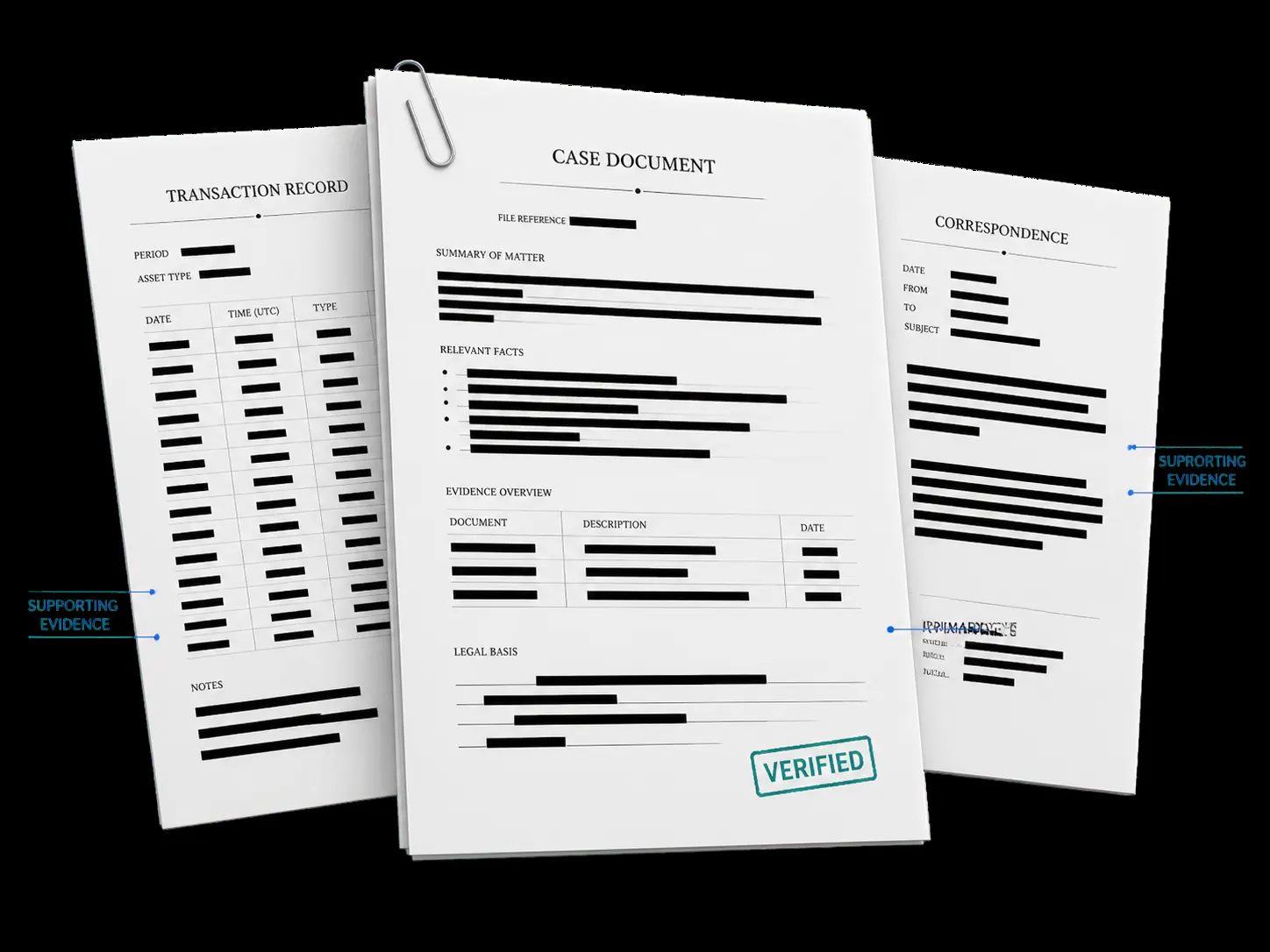 Case study
0.7 BTC Unblocked After AML/CTF Review by a Crypto Exchange
- Amount
- 0.7 BTC
- Issue
- AML/CTF transaction freeze
- Outcome
- Funds fully unblocked
 Case study
Bybit Account Unblocked Following a Compliance Review
- Amount
- 5 BTC + US$30,000 in USDT
- Issue
- Account restricted for compliance review
- Outcome
- Account access restored
 Case study
Bybit Account Unblocked After a Legal Opinion and Funds Review
- Amount
- Amount not disclosed
- Issue
- Bybit account restriction and source-of-funds review
- Outcome
- Account access restored
Get a Clear View of Your Options
Tell us what happened. We aim to respond in English within one business day.
- Evidence-led first review
- EU/EEA and cross-border support
- No seed phrases or private keys required