How Legitimate Crypto Recovery Works
For users in the EU and EEA, legitimate crypto recovery combines evidence collection, technical analysis and a lawful route to regain control of assets. Depending on the problem, this may involve a review by a crypto-asset service provider (CASP), a report to national authorities, a cross-border fraud investigation or court proceedings. Start by preserving transaction records and securing any accounts that may be compromised. Recovery is never assured: the outcome depends on where the assets are, who controls them and the applicable jurisdiction.
Which Type of Recovery Do You Need?
Before paying for assistance, identify what has actually happened. A suspended withdrawal and a transfer to a fraudster require different responses.
| Situation | Appropriate starting point | Key limitation |
|---|---|---|
| A genuine exchange or CASP restricts your account | Identify the restriction and answer the platform’s verification or compliance request. | A restriction does not itself establish theft. |
| You sent crypto to a scam or lost it in a hack | Preserve evidence, report the incident and assess the transaction trail. | Tracing does not give anyone control over the recipient’s wallet. |
| You cannot access your own wallet | Check legitimate backups, wallet files and the nature of the access problem. | Without usable recovery material, access may be impossible. |
| You sent assets to a wrong address or network | Check the transaction and contact the recipient or receiving platform. | Assistance depends on technical control and the recipient’s cooperation. |
A fake investment dashboard may show profits that never existed. Establish your actual outgoing payments and any genuine repayments before treating the displayed balance as recoverable assets.
What Legitimate Recovery Can Actually Achieve
Tracing Identifies a Route Through Transactions
An analyst examines addresses, transaction hashes and movements across relevant networks. The aim is to find useful leads, such as a transfer to a service that may hold customer records or assets. A credible report separates directly observable transfers from assumptions about address ownership and connections between wallets.
An exchange label in an analytics tool is a lead to verify. It does not prove who committed the fraud or that your funds remain there. Swaps, bridges and pooled accounts can complicate the analysis; off-chain activity may require records unavailable to a private investigator.
Control and Legal Authority Make Intervention Possible
A lawyer can assess claims, prepare requests and coordinate with relevant professionals. An analyst supplies technical evidence. Neither can compel an exchange to disclose customer information or transfer assets simply by sending a report.
The joint EU financial regulators’ warning on crypto-assets explains that crypto-assets can be highly risky and that the protection available to a consumer depends on the asset, service and applicable rules. A private recovery provider cannot create regulatory powers or compel a platform to transfer assets simply by sending a report.
Seizure and Return Are Separate Stages
Even when assets are secured, ownership and the process for returning them must still be established. Multiple victims, competing claims and proceedings in different countries may affect the result. A successful freeze is an intermediate outcome, not confirmation that payment to you is imminent.
The Europol report Cryptocurrencies: tracing the evolution of criminal finances describes how investigators follow crypto flows used in fraud and money laundering, while also highlighting the limits created by cross-border structures, pseudonymous addresses and off-chain activity. This is why a trace is an investigative lead rather than a promise of repayment.
What to Do First
-
Stop Further Exposure
Do not send additional money to unlock a withdrawal or validate a recovery. If an account is compromised, use the genuine platform’s security process and secure the associated email from a trusted device. For a compromised self-custody wallet, seek reliable technical help before interacting with unfamiliar contracts or recovery tools.
-
Preserve the Original Records
Export transaction history and save correspondence, website addresses and payment instructions. Keep original files alongside screenshots. Record dates and time zones, and avoid deleting chats or resetting affected devices before considering evidence preservation.
-
Build a Short Chronology
List when contact began, what was promised, each payment and when the problem became apparent. Separate facts you can document from suspicions. Include account identifiers and existing support or police reference numbers.
-
Notify the Relevant Platform and Authorities
Use the genuine exchange’s official support or fraud channel. Supply the network, token, amount, transaction hash and receiving address; ask for review and preservation of relevant records. Report suspected crime to the appropriate local authority without waiting for a paid tracing report.
-
Record the Response and Next Action
Save acknowledgements and deadlines. Ask what further evidence is needed and whether law enforcement must contact a dedicated channel. Update the existing case when possible, and distinguish an acknowledgement from confirmation that assets were frozen.
The European Commission guidance for scam victims advises victims to contact their bank, secure their accounts and report the scam to the relevant authority in their country. For a crypto incident, add the transaction hash, network, addresses, amount, platform details and the full communication history where available.
Documents That Make a Recovery Assessment Useful
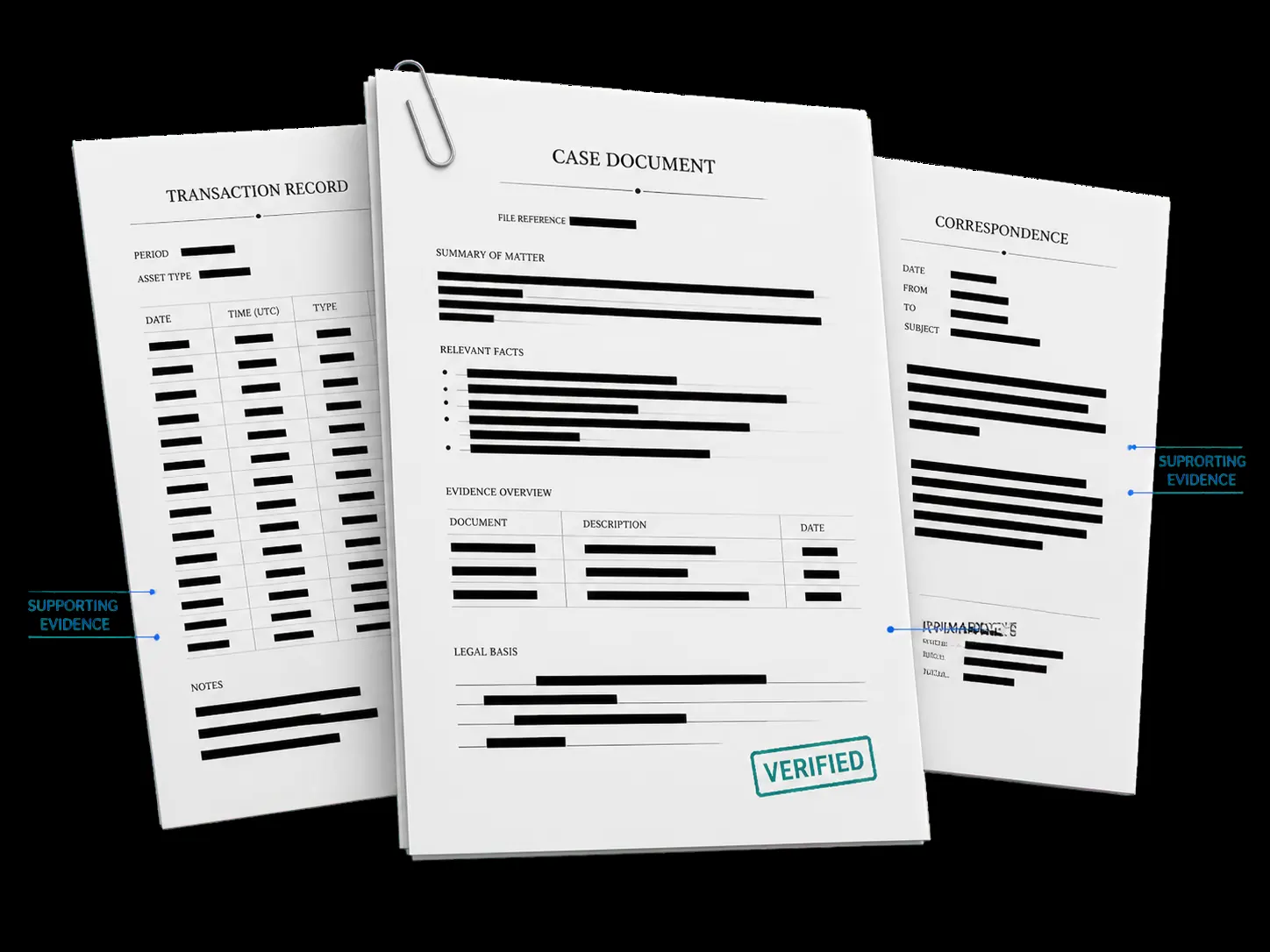
| Evidence | What it helps establish |
|---|---|
| Transaction hashes, network and addresses | The on-chain payments and starting points for analysis. |
| Exchange exports and bank statements | Your purchase, funding and withdrawal history; the connection between you and the payments. |
| Messages, emails and original payment instructions | The representations made and how the recipient address was supplied. |
| Website URLs, account screenshots and agreements | The service presented to you, claimed balances and contractual context. |
| Support replies and police references | Actions already taken, outstanding requests and the existing case history. |
| Wallet files or backup inventory for an access problem | Whether relevant recovery material exists; describe it initially without disclosing secrets. |
Practical tip: name files by date and subject, and add a short index linking each payment to its supporting evidence. Supply identity documents only through a verified channel when there is a clear reason to request them.
Security warning: Never provide a recovery contact with your seed phrase, private key, password, live 2FA code or unrestricted remote access to your device. Initial tracing and legal assessment do not require these secrets. Any specialist work involving sensitive wallet material needs a separately verified, secure arrangement with clearly defined access controls.
How a Case Progresses
There is no universal escalation ladder. Urgent preservation, police reporting and legal assessment may need to happen in parallel.
-
Assessment and a Defined Scope
The adviser checks the evidence, actual loss, likely jurisdictions and available route. Ask for a written explanation of what the first paid stage will produce, what it cannot establish and what would justify further work.
-
Targeted Analysis and Notifications
An analyst may prepare a documented transaction trail while counsel identifies the relevant entity and recipient of any request. A useful deliverable explains its assumptions and proposed next action. If no actionable lead emerges, further tracing should be reconsidered.
-
Platform Review or Formal Complaint
For restricted accounts, the next step may be a complete compliance response followed by the applicable complaint procedure. For stolen assets, the recipient service may require official legal process. A supervisory complaint is not automatically a mechanism for individual repayment.
-
Investigation or Court Proceedings
Where justified, authorities investigate or local counsel considers available disclosure and asset-preservation measures. Jurisdiction, evidence thresholds, costs and enforcement matter. There is no need to exhaust routine support where urgent legal action is appropriate.
-
Claim Verification and Possible Return
If assets become available, the relevant process may require proof of ownership and loss. Return can be partial or delayed, and recovery may remain impossible. Confirm the legitimate payment or distribution procedure independently before acting.
What MiCA Means for Complaints in the EU
If the relevant provider falls within the scope of the EU Markets in Crypto-assets Regulation (MiCA), the complaint route may be more structured than a general support ticket. Article 71 requires crypto-asset service providers to maintain effective and transparent complaint procedures, allow clients to complain free of charge, investigate complaints in a timely and fair manner and communicate the outcome within a reasonable period.
You can read the full rule in Article 71 of Regulation (EU) 2023/1114 (MiCA). MiCA does not guarantee reimbursement, reverse a confirmed blockchain transfer or cover every token, service or provider.
Before relying on EU regulatory status, check the provider’s legal entity and authorisation in the ESMA register. A brand name, local marketing page or an address in the EU is not the same as authorisation.
How to Check a Recovery Provider Before Paying
Look for a verifiable professional and a specific service, rather than a promise of a particular outcome.
- Verify identity independently. Check the contracting company and, where legal services are offered, the named lawyer’s professional registration. Contact them using independently obtained details.
- Request a written scope. It should distinguish analysis, legal advice, platform correspondence and litigation, with deliverables and exclusions.
- Clarify the full fee structure. Ask about retainers, additional stages, external costs and how any success fee is calculated, including partial recovery.
- Ask who can take the proposed action. A claim that assets can be frozen should identify the relevant platform process or potential legal route.
- Check evidence of any claimed progress. A wallet screenshot or a balance displayed on a new portal is not proof that assets have been secured for you.
An upfront professional fee is not, by itself, proof of fraud. However, guarantees, supposed government connections and repeated demands for an unexplained release payment are serious warning signs. Do not rely solely on testimonials, search placement or an unsolicited introduction.
Mistakes That Can Undermine the Process
| Mistake | Why it matters and what to do instead |
|---|---|
| Waiting for a polished report before reporting | Delay can reduce opportunities for intervention. Report available facts promptly and supplement them later. |
| Treating an address label as a proven identity | It may lead to unsupported accusations. Ask the analyst to state confidence levels and evidential gaps. |
| Counting dashboard profits as money lost | A fabricated balance distorts the claim. Reconcile actual payments and receipts separately. |
| Paying each new stage without a decision point | Costs can grow without an actionable result. Require a deliverable and justification before proceeding. |
| Publishing the entire case online | Personal details can attract further targeting. Share evidence through verified channels and coordinate public statements with counsel. |
When Legal Assistance Is Proportionate
Legal input is particularly useful when there is an identifiable platform or defendant, assets may be reachable, a formal deadline applies, or more than one jurisdiction is involved. It can also help where a genuine exchange repeatedly rejects a complete explanation or where ownership and payment records conflict.
Compare the next stage’s cost with the realistically recoverable amount, rather than the advertised loss or a promised percentage. Possible outcomes include restored withdrawals, a useful investigative lead, a freeze, partial return, refusal or no recovery. If assets cannot be located or reached, preserving the file and monitoring for new evidence may be more proportionate than continued spending.
Frequently Asked Questions
Can I report the loss without hiring a recovery company?
Yes. You can report directly to the relevant authorities and notify the platforms involved. Professional assistance may help organise evidence or pursue a specific legal route, but it is not a prerequisite for reporting.
How long does legitimate crypto recovery take?
A preliminary assessment and the return of assets have very different timelines. Platform responses, investigations and litigation depend on third parties and can take substantial time. Ask for a timetable for the provider’s own deliverables, not a guaranteed recovery date.
Can a company reverse a confirmed blockchain transaction?
A provider cannot generally undo a confirmed transfer on a public blockchain. Recovery may instead require a new transfer by the person controlling the assets or an applicable custodial or legal mechanism. A promise of a universal blockchain reversal should not be accepted.
Is an old case still worth reviewing?
Possibly, if records survive and there is a new lead, an identifiable recipient or an official claims process. Age alone does not decide recoverability, but missing evidence and legal deadlines can matter. Obtain a focused assessment before commissioning extensive new work.
What if my private key or seed phrase is completely lost?
If no usable backup, wallet file or other recovery material exists, access may be technically impossible. Knowing a public wallet address does not enable a provider to calculate its private key. A credible specialist should explain which existing material makes an attempt feasible.
Does a no recovery no fee offer prove the service is legitimate?
No. Check the provider and the agreement independently. Define what counts as recovery, whether other charges apply and when payment becomes due; identifying an address should not be confused with returning assets to you.
Legal Support for Crypto Asset Issues

Support when access, withdrawals or transactions are restricted.

Clear evidence mapping and structured responses to compliance requests.

Evidence preservation and coordinated escalation after a scam or disputed transfer.
Cases Related to This Topic
 Case study
0.7 BTC Unblocked After AML/CTF Review by a Crypto Exchange
- Amount
- 0.7 BTC
- Issue
- AML/CTF transaction freeze
- Outcome
- Funds fully unblocked
 Case study
Bybit Account Unblocked Following a Compliance Review
- Amount
- 5 BTC + US$30,000 in USDT
- Issue
- Account restricted for compliance review
- Outcome
- Account access restored
 Case study
Bybit Account Unblocked After a Legal Opinion and Funds Review
- Amount
- Issue
- Bybit account restriction and source-of-funds review
- Outcome
- Account access restored
Get a Clear View of Your Options
Tell us what happened. We aim to respond in English within one business day.
- Evidence-led first review
- EU/EEA and cross-border support
- No seed phrases or private keys required