Can Stolen Crypto Be Traced and Recovered?
Stolen crypto can often be traced across a public blockchain, but tracing does not itself return the assets. Recovery may be possible if investigators can identify a reachable custodian or person, preserve evidence, and use the right legal or platform process before the assets move again. Stop further losses and secure the affected accounts first. The prospects depend on the transaction path, available records, the provider and the countries involved.
First Identify What Was Actually Lost
The right investigation depends on how the assets left your control. A balance shown on a fraudulent website can be a fabricated figure, while the crypto you sent into that website may represent a real and traceable transfer.
| Situation | What can be traced | Immediate route |
|---|---|---|
| You sent crypto to a fake investment or romance scheme | Your real outgoing transfers and subsequent visible movements, if the receiving address can be identified. | Preserve payment instructions and hashes; report suspected fraud. |
| Someone accessed your wallet or exchange account | Unauthorised on-chain transactions and, possibly, the account access history held by the provider. | Secure accounts; alert the exchange security team and report the theft. |
| Your wallet approval was abused | Token transfers caused by the contract or spender; the precise mechanism needs technical review. | Revoke relevant approvals safely and secure remaining assets. |
| A website displays a large “profit” but blocks withdrawal | The real deposits you made; the displayed profit may have no on-chain counterpart. | Separate actual payments from dashboard figures. |
| A legitimate exchange has restricted your own withdrawal | The platform’s withdrawal and account records; it may not be a theft at all. | Use its support or complaint procedure for the specific restriction. |
If you merely sent funds to an incorrect address or unsupported network, the technical and legal options differ from a fraud investigation. Record the exact transaction and contact the receiving provider where there is one.
What Tracing Can Establish
As Europol explains in its report on criminal use of cryptocurrencies, many blockchain transactions can be followed publicly, although privacy techniques and some services can obstruct an investigation. The public record is a starting point, not an identity register.
An analyst begins with a verified transaction hash, network and address, checks whether the transfer succeeded, and maps subsequent movements. Blockchain Tracing and Crypto Evidence Analysis can be used where a more detailed transaction reconstruction is required. A recipient can send assets through several wallets, a token swap, a bridge to another chain or a custodial service. Each transition needs to be documented; a plausible-looking line on a diagram is not proof that one person controlled every address.
The analysis may produce several different findings: a confirmed transfer to a particular address; an apparent flow through other addresses; an indication that a service may control a deposit address; or an unresolved gap where funds are pooled or moved off-chain. Labels attached by an explorer or tracing tool are leads that should be checked, not conclusive proof of identity.
Where the Public Trail Becomes Difficult
Exchanges and other custodians can move customer funds internally without publishing every customer-level transaction. A mixer can weaken the link between its inputs and outputs; privacy-focused networks can conceal transaction details. Cross-chain movements and swaps require evidence that the movement on one network corresponds to the movement on another. Technical confidence should be stated at each step instead of presenting a speculative continuation as a verified trail.
The Difference Between Tracing, Freezing and Recovery
| Stage | What it means | What it does not mean |
|---|---|---|
| Trace | Document a path or identify a potential service touchpoint. | The recipient’s name or legal ownership is already established. |
| Identify | A provider or investigator links relevant records to an account or person. | That account still contains the same assets. |
| Freeze or seize | A custodian or competent authority restricts assets under an applicable process. | The victim has already obtained a right to receive them. |
| Return | Assets or compensation are released through the relevant legal or provider process. | Every loss or displayed profit will be covered. |
A legitimate recovery process may combine a trace, platform contact and legal action. A blockchain analyst cannot compel an exchange to disclose a customer’s identity or release an account balance. A private request may alert a service, but compulsory disclosure, seizure and adjudication depend on the applicable law and competent authorities. Even when assets are frozen, different victims or other claimants may assert rights to the same pool.
What to Do as Soon as You Discover the Theft
-
Stop the Loss and Secure Access
Do not send a “release fee” or additional crypto to the suspect. If a wallet or account is compromised, follow the urgent steps in How to Recover Stolen Cryptocurrency: First Steps. Change passwords from a trusted device, remove unfamiliar sessions or API keys, check token approvals and move unaffected assets to a new secure wallet where appropriate. Keep a record of what you changed.
-
Preserve the Original Evidence
Save transaction exports, hashes, network names, full addresses, payment instructions, chat exports, emails, URLs, account notices and any bank payment record. Capture the actual date and time, preferably with a consistent time zone. Do not delete the suspicious messages or overwrite the original files.
-
Contact the Relevant Platform
Use the official support or security channel of the exchange where your account was compromised or where the suspect may have deposited funds. Give a short chronology and exact transaction identifiers. Ask the platform to review the account, preserve relevant records and tell you what report or authority reference it needs.
-
Report the Suspected Offence
Follow the steps in How to Report a Crypto Scam and Preserve Evidence and report the suspected offence through the police or cybercrime reporting channel in your country. Supply the transaction schedule and the platform ticket number; ask for a report reference. The authority may later seek information or measures across borders, but an individual report does not automatically freeze assets.
-
Reassess Whether Further Tracing Is Useful
Once the first notifications are submitted, identify the last verified point in the trail and any service that might hold records or assets. Compare the amount at stake, likely reachability and cost of further work before commissioning an extensive report.
The joint European supervisory authorities’ factsheet on crypto frauds likewise advises victims to stop transactions, secure their accounts, contact the crypto provider through official channels and report the incident. It warns that an on-chain transfer generally cannot simply be reversed and that a second “recovery” offer may itself be fraudulent.
The Evidence That Makes a Trace Usable
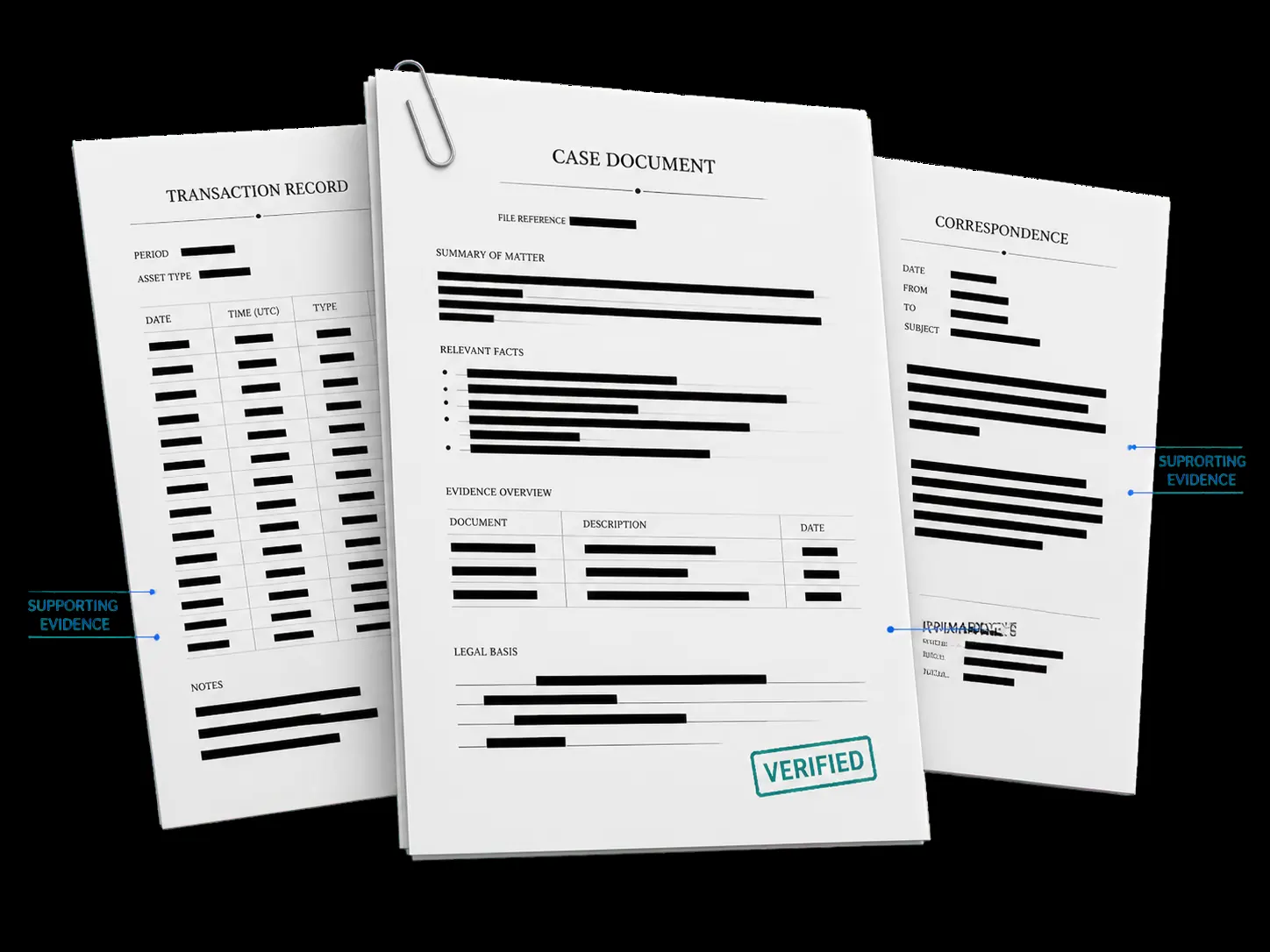
Give an investigator a small, organised file instead of a folder of unexplained screenshots. Include both the blockchain record and the evidence connecting it to your own loss.
| Item | What it helps prove |
|---|---|
| Hash, chain, asset and amount | That a specific transfer took place, and which network record should be examined. |
| Exchange withdrawal or wallet export | That the sending account or wallet was yours and the transfer left it. |
| Receiving address and instructions | Where you were told to pay and whether it matches the actual transfer. |
| Messages, invoices, websites and emails | Who instructed you, what was promised, and the sequence of events. |
| Bank statements and purchase receipts | The fiat funding leg and the amount of actual money committed. |
| Platform replies and police reference | What was reported, when it was reported and which questions remain open. |
Keep the complete original address and hash, even if a screenshot abbreviates them. For multiple transfers, number each one and match it to its instruction or receipt. Distinguish a verified fact from a provider label, a suspected connection and an unverified assumption.
Never give a seed phrase, private key, password, live two-factor code or unrestricted remote access to an investigator, lawyer or purported recovery service. Read-only transaction records and a verified channel are sufficient for an initial assessment.
What to Ask a Possible Receiving Exchange
A concise notice is more useful than a demand for an immediate refund. Send it through the platform’s verified fraud or security channel, preferably alongside your report reference:
“I am reporting a suspected theft or fraud involving [asset, amount] on [network]. My transfer [hash] was sent from [address or exchange account] on [date and time, UTC]. The relevant receiving address is [full address]. My police report reference is [number, if available]. Please review whether this address relates to your service, preserve relevant records, and advise how the competent authority should contact you. I attach a short chronology and proof of my outgoing transfer.”
If an explorer merely suggests a platform attribution, say so explicitly. The provider may refuse to confirm whether an address belongs to a customer or to discuss another person’s account. Retain its acknowledgement and give the case number to the investigating authority.
How a Recovery Route May Develop in Europe
A trace with a credible custodian lead can support a platform alert and a national police report. Depending on the facts, investigators may seek account records or urgent measures through the appropriate legal channels. A lawyer can help assemble a coherent claim, identify the correct entity and jurisdiction, and assess civil measures where they are proportionate. None of these steps guarantees an exchange freeze or a return to the victim.
For a concrete illustration of the distinction, Eurojust reported a coordinated investigation in which illicit crypto flows were traced and some crypto was frozen or seized. That operation involved public authorities across several countries; the report does not say that each victim’s assets were returned. It demonstrates the type of route that can exist, not a typical result or a template for an individual case.
Get a Free Stolen Crypto Case Assessment
Get a Free Case Assessment from P&P through our Crypto Scam Recovery and Crypto Fraud Legal Support service if you need to understand whether your evidence points to a reachable service or a legal step worth taking. An initial review should identify the proven loss, the last verified transaction and the main uncertainty before proposing paid work.
Outcomes and Limits to Plan For
- A usable trace but no identifiable custodian: preserve the report and case reference; further action may depend on new information.
- A plausible service lead: provide the evidence to the service and investigators; identity and account status still require verification.
- A freeze or seizure: keep records of your claim and follow the applicable process for recognition and return. A freeze alone does not entitle you to a specific amount.
- No realistic technical or legal path at present: stop spending on broad promises and retain the original evidence in case circumstances change.
Time matters because assets can be moved, but speed cannot replace proof. The legal route and practical reach differ between EU states, non-EU exchanges and self-hosted wallets. No one can calculate a guaranteed recovery rate from a hash alone.
Mistakes to Avoid
- Treating a dashboard balance as stolen crypto. Record the actual amounts sent and received; a fake platform can display profits that never existed.
- Assuming one labelled wallet identifies the thief. Ask how a service attribution was verified and what gap, if any, remains in the chain.
- Paying an advance “unlock” fee to a person who contacted you first. Verify identities and payment terms independently; report a second attempted fraud.
- Posting the full evidence file publicly. Exposed personal information can invite impersonation and alert suspects. Share it through verified channels.
- Waiting for a polished tracing report before notifying a platform or police. Report the facts you already have and supplement them later.
- Expecting an analyst to freeze a wallet or reverse a confirmed transfer. Ask for a clear first deliverable, its limits and the next decision point.
When Professional Help Is Proportionate
A technical review is useful where there are several chains, token swaps, a disputed service attribution or many transfers that must be matched to the victim’s records. Legal help is more likely to be worthwhile when a service, defendant or claimable asset is identifiable, several jurisdictions are involved or a court or authority filing is being considered.
Ask for a written scope and fee before commissioning further work. The first deliverable should say what is established, which conclusions are tentative, whom to notify and what would have to happen for money to be returned. If the next step depends on an unknown account balance or identity, say so plainly.
Frequently Asked Questions
Can a wallet address reveal the thief’s real name?
Not by itself. A public address records activity, while an account provider may hold information linking activity to a customer. Establishing identity usually needs provider records, other evidence or a lawful investigative request.
Can an exchange reverse a confirmed transfer?
A confirmed transfer on a public blockchain generally cannot simply be reversed by the exchange. A platform may be able to act on assets in accounts it controls, subject to its processes and applicable law. That is a different action from undoing the original transaction.
Does the trail end if the funds reach a mixer?
A mixer can make a direct link between inputs and outputs uncertain, so the confidence of any claimed continuation must be explained. Other evidence or subsequent service records may still matter. Do not accept a report that turns an ambiguous output into a certain destination.
How long can tracing or recovery take?
An initial check of a few public transactions may be quick; acquiring provider records and pursuing cross-border legal measures can take much longer. There is no reliable universal timeline. Ask what stage the case is in and when the next meaningful update is due.
Will the police return crypto if I supply a hash?
A hash is a useful identifier, but it does not prove ownership, identify the offender or establish where recoverable assets are held. Provide evidence of the loss and your connection to the sending funds as well. Recovery depends on the investigation and the relevant legal procedure.
Legal Support for Crypto Asset Issues

Support when access, withdrawals or transactions are restricted.

Clear evidence mapping and structured responses to compliance requests.

Evidence preservation and coordinated escalation after a scam or disputed transfer.
Cases Related to This Topic
 Case study
0.7 BTC Unblocked After AML/CTF Review by a Crypto Exchange
- Amount
- 0.7 BTC
- Issue
- AML/CTF transaction freeze
- Outcome
- Funds fully unblocked
 Case study
Bybit Account Unblocked Following a Compliance Review
- Amount
- 5 BTC + US$30,000 in USDT
- Issue
- Account restricted for compliance review
- Outcome
- Account access restored
 Case study
Bybit Account Unblocked After a Legal Opinion and Funds Review
- Amount
- Issue
- Bybit account restriction and source-of-funds review
- Outcome
- Account access restored
Get a Clear View of Your Options
Tell us what happened. We aim to respond in English within one business day.
- Evidence-led first review
- EU/EEA and cross-border support
- No seed phrases or private keys required